Tuesday, 24 December 2013

Ocana 1809 & Desk Tidy

So, a couple of weeks ago I was looking at my painting desk, and for obvious reasons decided to have a bit of a tidy up (there is also a shelf you can't see that has various figures primed but not yet painted). My next thought was that I should clear up the numerous half finished projects (in 15mm alone there are Spanish ABs, AB French artillery, some AB early Austrian Chevau-Leger waiting to be painted as Spanish cavalry, AB Austrians and a few OG French).


As I returned some figures to the Bollinger box where they belonged I resolved to have a clear out. So a few figures were despatched to Paul ( Napoleonics In Miniature ). And since then I've been fitting in a bit of time whenever I can painting up odds and ends. One thing that has irritated me no end is the number of Citadel Paints (particularly the new pots) that have dried solid over the last few months.

I've also been admiring one of my new acquisitions - the French Histoire et Collections volume, Ocana 1809, this is a very nice English language volume in the same style as Hourtelle's books on Wagram, Austerlitz and so on. It has maps, reports from French officers after the battle, and the very useful uniform plates we expect. 


The other book (in Spanish) is also called Ocana 1809 and has better maps and some uniform plates - it also has an OOB with numbers for each battalion. It is an Osprey style of book - they have quite a selection of books on other subjects too - I picked up two of these while in Valencia in late September (Medellin 1809 and Almonacid 1809) but my Spanish isn't good enough to make much out of the text. I think if Guerreros y Battallas were to publish these books in English they would do really well - many of the subjects aren't covered elsewhere at all. 


Ocana was quite an interesting battle - at the end of 1809 the Spanish, emboldened by their success at Bailen, made a dash for Madrid with an army of 53,000 men. The French, taken by surprise, managed to concentrate 40,000 men under Soult - although smaller in numbers, the French units were mostly veterans, whereas many of the Spanish were freshly raised units. The French attacked against a strong Spanish position (there was a ravine across the front of much of their position), their dragoons drove in the Spanish cavalry on the flanks and the French infantry attacked, the Spanish broke, thousands were captured and Madrid was secured for Joseph for some years. Ocana was one of the pivotal battles of the Peninsular War and, because the British weren't there, mostly ignored by English writers.

I've started working on more Spanish infantry, and have bought appropriate flags from Adolfo Ramos, and recently a couple of sets from Pete's Flags - both of these produce very nice flags. I've also been looking at 15mm artillery for a review (this little project has turned from a short post into a very long post - but hopefully I should have something up next week), and now have a glut of guns to join the excess of everything else in my leadpile!

Have a very happy Christmas everybody!


Tuesday, 19 November 2013

Napoleon's Waterloo Campaign: An Alternate History


Napoleon's Waterloo Campaign: An Alternate History by Steven Marthinsen is an interesting book - I picked up the first volume back in March of this year whilst browsing Amazon (I'd been buying books on the Spanish  Army and this popped up in the "other customers bought this..." section), and got the second volume soon after. The book imagines what would have happened had Grouchy marched to the sound of the guns, disrupting the Prussian march to aid Wellington and catching the English on the flank.

In some respects it reads like a Victorian military history book (the kind you see reprinted as facsimile copies), and this image is enhanced by the maps, which look are drawn in an old fashioned style. It is a slightly odd merger of quotations from individual soldiers which open each chapter, operational history and novel. Marthinsen clearly has a well developed sense of  how Napoleonic armies worked and uses this knowledge to paint quite a convincing picture of several days of fighting - I say several days, as the book covers the early part of the campaign "as written" - so Quatre Bras and Wavre are handled as they really occurred - but once Grouchy determines to march to the sound of the guns things quickly take a new direction (in the most literal sense).

Now I have a few issues with the books (there are two volumes) - the first is that they are quite expensive (this is a self published book produced by exLibris which I think is the reason), and the second is that they seem to be written by Marthinsen as if they were a fantasy where Napoleon wins - lots of things go well for the French, and not so well for the Allies. I couldn't help feeling as I read the book that Marthinson would be the kind of wargamer happy to have national modifiers in the rules he played. However, I'd emphasise that this isn't too overdone and is more than made up for by Marthinson's handling of the battle scenes (which is the bulk of the book).

I'd say that if you had built armies covering the Waterloo Campaign but had grown bored with trying to take Hougomont for the umpteenth time that there is ample material for a scenario author to work through, whatever the scale of action covered by his favourite rules. There are lots of incidents and actions, both small and large that would work as a subject for a game.

In short I rather recommend the two volumes - whilst I've never been that interested in the 100 Days (although the cobbling together of the French Army in such a short space of time fascinates me) I really rather enjoyed these books.

Apologies for being rather invisible over the last few weeks - as I work in the wine trade the run up to Christmas tends to be rather hard work (no days off this month and several late nights too). On the other hand working at wine tastings is great fun and gives me the opportunity to try new wines and make new friends. This last weekend was the Decanter Fine Wine Encounter which is the highest quality wine tasting in the British calendar (and probably, on the face of it, the most expensive at £50 a ticket) - I was pouring both days which allowed me to sneak off a bit and try wines from producers I'd read about but not drank. My big "find" of the weekend was Alpha Estate from Macedonia (the Greek region, not the country) - I'd read about this producer in the trade press and seeing their table was quiet (it always amazes me that even the supposedly wine-literate attendees of Decanter breeze past the winemakers from the less well known regions and countries in favour of crowding around some jerk from Bordeaux or Napa who isn't making anything near as interesting) I thought I'd take the opportunity.

And I was blown away by them - the Malagouzia was a super cool melony white wine that I just adored - perfect for seafood or meze type meal and the Xinomavro was an absolutely delicious red leathery wine with great structure and body - would be great with lamb. My new best friend, Kostas the Export Manager, took me through half a dozen of the estate wines. I wasn't quite so convinced when they went with straight classic varietals (Syrah and Sauvignon Blanc - although Jancis Robinson scored their S/B at 17 out of 20 so she likes them) but they did some blends (so Sauvignon Blanc & Malagouzia, and Syrah / Xinomavro) that were vary successful. And the RSPs were good too between £13 and £26 if I understood Kostas correctly.

So when the consumers (I work for an importer so "customers" are wine merchants and supermarkets - the people who finally buy and drink the wine are "consumers") asked whom I recommended to try Alpha Estate were the first (Bischofliche Weinguter Trier from the Mosel, and Chateau Ksara from Lebanon were also high on my list). And at the end of the weekend Kostas gave me a bottle of their top of the range red which was a lovely surprise - "enjoy with friends" he said as he headed back to his own table.


Sunday, 20 October 2013

15mm AB French Line Infantry And A Minor Disaster

I had a minor disaster yesterday. I subscribe to Miniature Wargames / Battlegames now that Henry Hyde has taken on the editorship and the new issue arrived on Friday morning. I left it on the coffee table whilst I went and did the grocery shopping and Archie (the younger of my two dogs) decided to eat it for lunch - here are the results:

Obviously Archie is severely in the doghouse - although he doesn't seem too upset about it:

Clearly he isn't a fan of the new editorial direction at MW/BG!

I haven't done much painting over the last few weeks So, with little further ado, here are a couple of photos of the other super-duper unit I bought from eBay along with the Highlanders. I think it is a really beautiful unit - whomever painted these added patches to the trousers of some of these figures and you can actually see the stitching painted on the patches. And the faces just look wonderful - way more brush control that I have ever been able to manage.

This one is again based on four bases - this time though there are four grenadiers and four voltiguers. This means that I could just break it up and rebase it as a 24 figure battalion, but I have a few painted French Line that I did some time ago that I think I could possibly try and match in. I'm thinking that if I took all these great figures off their current bases they could make up the front rank of the unit, and my inferior efforts could fill out the rear rank (which would only become a concern if they were forced to retreat). I have some AB greatcoated flankers that need painting so purloining four of those would give enough figures to make up the grenadiers and voltiguers to full strength.

And today it just bucketed down this afternoon. We had a small flood in the street outside as the excess water flowing down the hill from High Barnet popped the manhole covers:


Saturday, 19 October 2013

28mm Perry WotR Figures Possibilities and a Flight Of Fancy

My main focus is 15mm Napoleonic (although I also have rather larger 15mm ACW armies as well) but a few years ago, when the Perry plastic Bills and Bows set appeared at Salute I was smitten. Despite knowing very little about the period I pressed my money into the hands of the Perries and made off with three boxes (so about 120 figures). I then found I was a bit intimidated by these figures - people like Captain Blood and Admiral Benbow on Lead Adventures Forum were producing beautifully painted figures (and really neat conversions). And then just look at the Je Lay Emprins and Stuart's Workbench for just wonderful use of these plastic figures.

But I still loved the idea of doing something with these figures, so I added three boxes of the "Mercenaries" set, and a box of Mounted Men at Arms (all picked up from eBay at a bit of a discount). I've added some Swiss and European heads and a box of Unarmoured Swiss Pikemen but haven't really gone in for the metal figures - but the news of the price rise at the end of August has made me look at these figures again. It would also help if I could think what to do with them - after all, it isn't like buying a box of Perry British Line Infantry where the big decision is "stovepipe or Belgic" - these figures could be used pretty much anywhere in Western Europe at the time.

So I could build a couple of contingents for the Wars of the Roses - after all, there were foreign mercenaries, English longbowmen, nobles stabbing each other in the back at the drop of a hat - lots of things that appeal to the wargamer.

Or I could slavishly follow Je Lay Emprins (if you are going to slavishly follow pick the best, I say) and build some Burgundians and Swiss. This has lots of appeal to me.

Or there are the early Italian Wars - French, Swiss and various Italians - all very colourful and again lots of backstabbing. I have the Fornovo book by Osprey.

It did occur to me that possibly I could "do" the Reconquista in Spain - rather disappointingly that was pretty much all done bar the shouting by the mid 14th Century - there was the Conquest of Granada between 1482 and 1492 but there isn't much info that I can find for this. I think the Spanish armies could be covered by the Perry plastics (with careful choice of heads) and probably some figures from the Foundry Conquistador range but the Emirate of Granada would be more difficult (I'm thinking the Perry Bedouins from the Muslim Crusader range might work as a base to build on but other figures would be tough to find). I've picked up the relevant Osprey books since I first typed this and the campaign really has lots of appeal - I've also got some flags from eBay that are suitable for Castile, Aragon and Naples and I think a Spanish army from the late 1400's is the way to go - the Perries don't yet do Spanish heads but I'm hoping they will, after all they would be useful in both Spain and Italy.

I also had one totally mental idea sparked by one of my younger colleagues in the office saying that Columbus discovered America in 1492 - the pedant in me said "no, he discovered the Bahamas, various Caribbean islands and Venezuela, John Cabot has a better claim for North America." This lead to a brief conversation where I explained Cabot led three voyages to North America and died on the third (which in fact is evidently debatable). Thinking about this later a little light bulb went on in my head - what if Cabot hadn't died?

Cabot led an expedition in the Summer of 1496 that failed. Upon his return, he met Henry VII, and managed to gain support for a second voyage "This year, on St. John the Baptist's Day [24 June 1497], the land of America was found by the Merchants of Bristow in a shippe of Bristowe, called the Mathew; the which said the ship departed from the port of Bristowe, the second day of May, and came home again the 6th of August next following." (From Wikipedia, quoting a 1565 source). Based upon this success he was given support to launch a five ship expedition (including one ship funded by Henry VII) - unfortunately he pretty much drops off the record after that and it is assumed his fleet was lost at sea (although there is now evidently a bit of debate about whether that was the case).

But what if Cabot hadn't been lost at sea? His final expedition included a number of interesting people including some monks intent upon converting natives. The voyage was backed by Bristol merchants (and the King) as a business venture. I can kind of see the meeting in my mind's eye: "Well yes your highness, the fishing off the coast is superb, there are lots of trees on the mainland, it looks like the Baltic with all the trees so I guess there will be furs available too."

Henry VII was a king who kept England out of foreign wars and aimed to build up trade. Fish was a key source of food (all those Holy Days), England needed timber for shipbuilding, and furs would be nice too. England already imported all these commodities from the Baltic countries but if he could get a source that cut out the Hansa cities that would be better. When Cabot returned from the New World Henry VII had just polished off the Perkin Welbeck revolt in Cornwall - this had gained Henry £13,000 in fines (his average annual income was £100,000 during his reign) and 6,000 prisoners. I can see Henry deciding that sending revolutionaries several hundred miles away across the ocean to live out their lives while earning a profit from them was a win all round.

So, what if John Cabot had established a colony on Newfoundland? The purpose of the settlement would be to support fisherman visiting the area to fish for cod by supplying fresh food (which would help with scurvy  -although this idea hadn't been thought of yet), and repair facilities should fishermen need them. The provision of timber for spars would be a useful cargo for returning ships too. The settlement could also act as a trading post for contact with the natives - allowing the Europeans to buy furs - and also act as a base for further exploration of the New World by the English. And obviously be a dumping ground for criminals, malcontents and the poor (ie the traditional English method).

From this would follow some quite interesting ideas based upon colonisation starting a 100 years earlier than in reality and England being early to the party - the first confrontations with the natives would be rather less one sided than they historically were, so possibly a rather different dynamic would develop (of course the natives would still come down with smallpox so the Europeans are still likely to come out ahead). French Canada might not appear. Instead England would confront Spain as they tried to enforce the Treaty of Tordesilles. Of course what would happen to the nascent North American colonies once Henry VIII came to the throne is debateable (he conciliated Spain and confronted France so a few piddling colonies in North America might have been considered an impediment).

For wargaming purposes it would be the Perry figures (plus some Foundry Conquistadors) versus the native Indians - Brigade Games King Philips War Indians perhaps? This would be skirmish wargaming, I guess. I suppose success in winning skirmishes could be translated into rewards for the ongoing campaign (a bit like in Dux Britanniarum by Two Fat Lardies).

Apologies for no pictures in this post - "normal" service will be resumed shortly.


Sunday, 6 October 2013

L'Iber Museo de los Soldaditos de Plomo - Valencia, Spain

Apologies for going quiet for the last few weeks. Work has been fairly busy (including visits to Scotland, and Champagne), I've also completed Battlestar Galactica and have moved on to watching another series I always meant to see - The Wire (I'm very much enjoying Bunk and McNulty). But the main distraction was ten days in Spain, visiting Barcelona and Valencia with my wife. I hadn't been to Barcelona in 15 years or so and had never been to Valencia so I was rather looking forward to it.

Barcelona was wonderful - but slightly spoiled by the hordes of tourists everywhere you went. We had a great time. However, what had sold Valencia to me when I was looking for where we should go was that Valencia is home to one of the world's largest toy soldier museums - L'Iber Museo de los soldaditos de plomo. 80,000 figures on display in an old mansion house in the centre of the old city in Valencia. When I saw this place pop up on Trip Advisor it was as if God had spoken!!

I've added a link to the Museo's website to the right - but for those of you too lazy to go look, the collection is the work of a gentleman called Mr Alvaro Gimenez who collected toy soldiers all his life, and in the 80's started a museum in an old mansion house in the city. Now I have to say, if you do not speak Spanish this place isn't that user friendly - once in the Museum itself all the signs are in Spanish, essentially, you pay the 5 Euro, are given a very small floorplan of the mansion and allowed in. After that you are on your own (literally, for large parts of my visit).


Each room of the mansion is home to numerous glass cases full of (mostly) 54mm toy soldiers. I'm not into 54mm toy soldiers too much myself but I defy anyone interested in our hobby not to feel their heart lift as they see rank upon rank of these little guys. Most of the figures are of Spanish subjects and are from a variety of makers (Almirall Palau, Elastolin, King & Country, Rose and Pheonix amongst many others)..

Amongst the rows of display cabinets are some diorama style displays - this is just a small detail of a large display loosely based upon Waterloo.


However, in amongst the ranks of 54mm lovelies there were at least two large dioramas - one was in 15mm and featured Greeks and Persians squaring off - as I understood the label, all the figures were by a small figure line by Almirall. From what I could gather they were originally bought ready painted in small boxes of two to four figures.

There were two dioramas that featured 25mm Minifigs and Hinchcliffe figures - one was the battle of Almansa 1707, and the other was an Egyptian battle (lots of chariots). I've got to say - I rather look down on both Hinchcliffe and Minifigs these days (although I had a fair few back when I was a small boy) but these two tables showed them to their best advantage en masse.


I spent a thoroughly enjoyable hour and a half wandering around the museum. It was absolutely delightful - I was particularly pleased to see some Pheonix Miniatures figures there (Napoleonics and civilian ladies mostly) - when I was about 12 I started buying their 25mm Napoleonics - they were beautiful figures (I was a lead snob even then).

Overrall, I'd recommend Valencia - Barcelona was wonderful but so full of tourists it began to be a bit wearing, whereas Valencia was a bit more laid back. I'd say it was an excellent choice for a long weekend if you just fancy mooching around the cathedral, hitting a couple of museums, shopping in the small shops throughout the old town or going to the beach. We also ate particularly well in Valencia - and I enjoyed one rather exciting local wine that particularly stuck with me - Dominio de la Vega Artemayor -  a single vineyard red from old vines made from the local grape variety, Bobal. Interestingly, it is a non vintage wine (the bottle I drank was made from the 2006, 2007 and 2008 vintages vinified individually and then blended). Apparently it is a small production wine (<5000 bottles per annum) - and is the top of their range (47 Euro in a local restaurant so not too outrageous). Layton's are the UK importer for Dominio de la Vega (they also do quite a useful cava but I haven't tried their cheaper light wines) but the Artemayor isn't on their published list. I suppose I'll need to get my salesman on the case...  

Wednesday, 28 August 2013

Fighting 15s At Colours 14/15th September

So, I don't have a Facebook account (or Twitter - I firmly believe that any idea that can be expressed in 147 characters or less is so obvious it doesn't need to be stated, or so shallow it shouldn't be discussed in that forum) so I missed this little drama when it first arose. Anyway, as Ian Marsh sells my favourite wargames figures in the world, and I'd like to see him continue to have food on the table (only so he can continue to very efficiently sell me figures that I don't really need whenever I have the urge to buy them) here is a straight lift of an entry on Oozlum Games blog from a few days ago. Please go along to Colours and buy some figures from him - but while you are there ask him to ask Mr Barton if he couldn't add some French line infantry marching in bonnets de police and such like.


Above is the advert that should have appeared in the Colours show guide and issue 365 (September 2013) of Miniature Wargames. Unfortunately, because of an error in Miniature Wargames’ ad production, the wrong advert will appear.
The above advert was to be used to key in to a new display of Eureka’s 18mm Seven Years War figures at the show, on which I have been working all summer. I am keen to promote this range now that it is being cast in the UK under licence, allowing me to reduce the prices, and advertising in the Colours issue of Miniature Wargames was a vital part of drawing wargamers’ attention to the range.
Over the past 24 hours there has been a moment of, shall I say, uncharacteristic fiery incandescence on my part directed at Miniature Wargames’ outsourced ad sales team at Media Shed. Editor Henry Hyde, however, rang me this morning, having talked to the publisher, and has settled the matter to my satisfaction.
So, I will be at Colours on 14 and 15 September, as usual with Black Hat Miniatures up on the first floor. I will have painted examples of Eureka’s lovely 18mm SYW figures on display in the cabinets. I will even have stock of the range at the show, but as usual the advice is order in advance to guarantee that I have what you want at the show.
Ian
Owner, Fighting 15s

Sunday, 25 August 2013

Something unusual in the back garden. And identify this castle?

I live in a street in North London that is plagued in the mornings by parents dropping off their little darlings at one of the numerous local schools. I used to walk or ride a bike to school - and I can't see why the blighters can't do that today - of course if you were to ask the parents that question the response would be that there was too much traffic for their children to walk safely to school (of course - it never occurs to them that they are the traffic at that time of the morning!).

Anyway, every so often on a Friday or Saturday night we sometimes get the odd drunk toss his empty beer bottle onto our front lawn. The following morning, I sigh, and pick them up. After all, I work in the drinks industry and I can hardly complain if someone enjoys the product a bit too much (although when they've been drinking Dos Equus I have to question their taste in beer). Anyway, I'm sure some of  you have had the same experience (or, - shame on you - have dumped an empty in someone's front garden yourself).

So, about a year ago my wife and I paid a quick visit to Beirut. While we there we visited a cousin, Sally, at her family home up in the hills above the city - they had built a beautiful house and garden by a steep hillside (practically a cliff), safe in the belief that nobody would be nuts enough to build there - and guess what? Over the next thirty years the house became surrounded by the usual sprawl of houses and apartment blocks (Beirut has no planning laws as far as I can tell).

Sally's Dad is pretty old and I said I'd help clear up the yard, which was very overgrown. And while we found some empties (the local brew, Almaza, is actually quite nice) what brought me up short was to find something Russian in the back garden - and I'm not talking empty bottles of Baltika:

So this is it a few days later after a clean up (don't ask where the clip came from). We think it was tossed over the garden wall by some fleeing militiamen during the war but at the same time seems to be missing some parts that I'd expect to see if it had been thrown aside in a panic.
And here am I the militiaman!

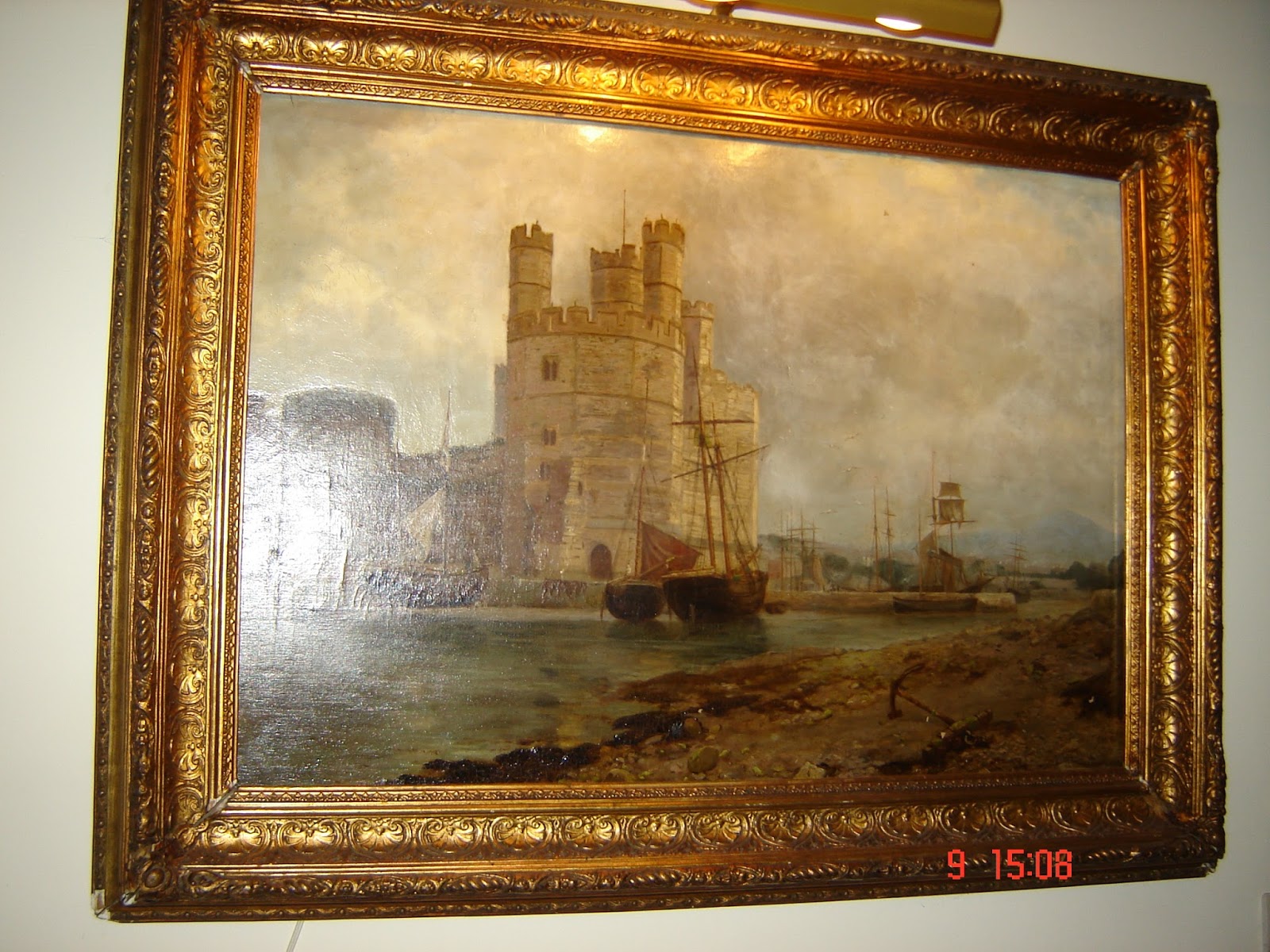
The other thing they had that caught my eye was a painting in the library:


Now this was a painting that Sally's Dad had picked up when he was working in London (he was a surgeon before he retired) but he knew nothing about it. It looks to me like a castle built by Edward I to secure the Welsh conquest but I don't recognise the castle. Of course it could be a stylised depiction, I suppose. If anyone has any suggestions for it being an actual place, please let me know.