I guess most of the people who look at this blog will have read Band of Brothers by Steven Ambrose, or have watched the TV series of the same name. Band of Brothers was about the men of Easy Company, 501st Battalion, 101st Airborne in 1944-5. Black Hearts ( Link to Amazon page for this book )by Jim Frederick is about Bravo Company, 502nd Battalion, 101st Airborne during 2005-6 - sixty years on and warfare has changed immensely as has the pressures on the young men who fight their nations wars. This book has, at it's heart, a terrible crime committed by four drunken youths - the murder in their own home of a husband and wife and their two daughters, one of whom was raped before she was killed. The fact that the drunken youths were serving American soldiers makes the book all the more shocking. But, to put the crime into context, Frederick details the travails of Bravo Company in the Triangle of Death - and the whole book is appalling.
I've only read the book and not read more widely on the subject - so my views are based solely upon Black Hearts, which is always a bit risky. But, I've been told it is on the reading list at West Point - which I guess means at least someone thought it was on the money.
Bravo Company were sent to an area South of Baghdad referred to by the media as The Triangle of Death. The first surprise for many British readers is that the Americans fighting this war were not blessed with every technological advantage known to man and huge reserves of manpower to throw at situations. This is a battalion of "light infantry" (as in they don't have heavy APCs etc) who have been dumped in the worst part of Iraq at that time and told to manage an area that was several times too large for their numbers (at this point I started to get serious deja vu thinking of the book I read awhile ago on the Welsh guards deployment to Helmand). They also have the misfortune that their battalion commander, Lt.Colonel Kunk, appears to have stepped straight out of a Joseph Heller novel (by the end of the book you may well feel that Kunk is a mispronunciation of his name).
The book addresses the thinking that many people have that Iraq wasn't a "proper war" because it wasn't full on combat a-la WWII. Frederick addresses the pressures of low level counter insurgency warfare being fought on a daily basis for months without respite very well, pointing out that WWII soldiers were usually rotated in and out of the line on a regular basis whereas these poor guys were pretty much at the sharp end for the duration of their tour.
The men of 1st Platoon, Bravo Company, 502nd Airborne had the misfortune to be serving in the worst place in Iraq at the worst time - force levels were low, the search and destroy tactics used were clearly failing but it would be another year or so before senior command were prepared to admit this. The guys on the ground knew that what they were being asked to do was futile, given their level of resources, and yet nobody seemed to have any other solutions. They were in the butt end of nowhere being attacked on a daily basis, living in appalling conditions at the wrong end of a very long supply line. The lack of coherent strategy for the war flowed down from Pentagon to battalion and below with demoralizing results.
This book was an eye-opener for me on a number of levels. Apart from the fact that the 502nd were often short of equipment, Frederick writes extremely well describing the events that led up to the murders - this should be required reading for soldiers at all levels. He also covers the pressures (as of the middles of the last decade) that caused the US Army to recruit men like the four accused (one in five recruits had "moral waivers" that allowed the army to overlook prior criminal convictions), and how a lack of support and supervision in the field allowed them to do what they did.
He also covers the investigation and trial of the men involved. One of the final chapters includes a note of what the various people within the battalion were doing at the time of writing the book -if anything, this was the part that I found most shocking - as far as I could see these four boys behaved appallingly but their chain of command was responsible for where they were, how they were supported, their tactics and so on. And pretty much everything about that was screwed up by NCOs and officers at all levels within their chain of command who failed to appreciate the situation on the ground - or who ignored the issues knowing that in a "can-do" army that admitting that the mission couldn't be done with the assets at hand wouldn't help their prospect of higher command in the future.
This leadership failed at pretty much every level, from Rumsfeld on down. But, after reading the book, I defy anyone to think that Lt Col Kunk was anything other than a complete w***** who couldn't run a whelk stall let alone a battalion - and yet he wasn't dismissed from the service (which was what I expected to see when I looked at his entry) - his "punishment" was to be given a "letter of concern" (on the need for "an absolutely clear and concise flow of information down to the platoon level") - the minimum level of reprimand. No, he was promoted to Colonel in July 2009 and, at the time of the book being written (2010) was serving as "chief of current operations in the army's Operations, Planning and Training office at the Pentagon." Which seems quite scary to me.
Unsurprisingly, as a book about a war crime committed by US Army soldiers, this book hasn't sold as well as Band of Brothers. I picked it up remaindered for £1.99. Yet this book has just as much to say about how men react to war as Band of Brothers, or Sebastian Junger's War.
Sunday, 4 August 2013


Sunday, 14 July 2013
42nd Highland Infantry (The Black Watch) aka The Collaborators*
Apologies for having gone a bit quiet over the last month - a few work related customer visits impinged on my hobby "stuff". The result of this is that I've done very little painting of anything over the last few weeks. However conscious that I haven't posted anything I thought I'd post some pictures of these figures that I bought from ebay some time ago.


* My mother, an occasional Jacobite and full time Scot, always referred to the Black Watch as "The Collaborators" - a reference to their origins " In 1725, following the Jacobite rebellion of 1715, General George Wade was authorised by George II to form six 'watch' companies to patrol the Highlands of Scotland, three from Clan Campbell, one from Clan Fraser, one from Clan Munro and one from Clan Grant. These were to be "employed in disarming the Highlanders, preventing depredations, bringing criminals to justice, and hindering rebels and attainted persons from inhabiting that part of the kingdom." The force was known in Gaelic as Am Freiceadan Dubh 'the dark' or 'black watch' "
Of course my mother said the name was not a reference to the dark plaid they wore but to their "black hearts" in keeping down the Scots. My mum was not alway logical but there was always something of the rebel about her!
Now they were labelled as Highland Infantry, and looked quite nice in the auction photos but it was quite hard to tell just how nice they were. I also couldn't tell how they were based, or the make up of the battaion. Anyway, I decided to go for it and got them for a bargain price. When they were arrived I was blown away by the quality of painting - easily up to the standard of the best I've seen, and much better than my own amateur daubing.

However they aren't without issues - they are beautifully based on four 40mm x 30mm stands that don't match the rest of my "army" (I put inverted commas because I'm not sure you can call a couple of battalions of British Line an "army"!), and there are only four flank company figures - two light and two grenadiers. Although very nicely done I don't think the painter has quite caught the "Black Watch" tartan - the tartan on the figures is a shade or two too pale. The final problem is that 24 figures in GdB terms is only 480 men - and the 42nd (mostly) had rather more men under arms than this throughout the Peninsular War (see this link for a fascinating history of the battalions in the Peninsula, including their numbers at each significant point - PUA = Present Under Arms: 42nd Numbers ).

Nevertheless, these figures look superb. The painted figures are AB, and I have some unpainted Highland centre company infantry (an ancient Battle Honours blister pack of twelve figures bought from Duke Seifried on Ebay which match perfectly). I'm currently contemplating whether I dare try to replicate the style - I'm fairly confident I can do them to a "good" standard but not so confident I can paint to this standard - whomever it was did these they even painted the lips on each face - and did it in a subtle way. Perhaps I can slot the additional figures into the rear rank where my incompetence won't be too obvious. Obviously if I add in some centre company figures, I'll need to add some flankers too (can't have a "project" that doesn't require buying some more figures!).
* My mother, an occasional Jacobite and full time Scot, always referred to the Black Watch as "The Collaborators" - a reference to their origins " In 1725, following the Jacobite rebellion of 1715, General George Wade was authorised by George II to form six 'watch' companies to patrol the Highlands of Scotland, three from Clan Campbell, one from Clan Fraser, one from Clan Munro and one from Clan Grant. These were to be "employed in disarming the Highlanders, preventing depredations, bringing criminals to justice, and hindering rebels and attainted persons from inhabiting that part of the kingdom." The force was known in Gaelic as Am Freiceadan Dubh 'the dark' or 'black watch' "
Of course my mother said the name was not a reference to the dark plaid they wore but to their "black hearts" in keeping down the Scots. My mum was not alway logical but there was always something of the rebel about her!
Tuesday, 11 June 2013
15mm Xan Mimiatures & Campaign Game Miniatures British Line Infantry
Well, last week the big news for me on TMP was that Xan miniatures had produced some new British Line Infantry in stovepipe shako suitable for the Peninsula. Now, I adore the AB sculpts and painted a battalion (in a rather poor fashion) last year ( http://tenfiguresaweek.blogspot.co.uk/2012/06/57th-regiment-of-foot.html ) but I'm always looking for some new figures. And these are much cheaper than the superlative ABs.
It so happens that I've been looking around at British infantry suitable for the Peninsula lately. I rejected Old Glory because of their inconsistency between ranges (or indeed bags within ranges), Fantassin (Warmodelling) were kicked into touch for the same reason. I don't like the stumpy Essex figures. Which rather left AB and BH in the quality 15mm field. Until recently that is.
Many Americans are admiring the Blue Moon 15mm range and I took a look at the British Line Infantry in Stovepipe here last year ( http://tenfiguresaweek.blogspot.co.uk/2012/06/blue-moon-xan-miniatures-review.html ) - if you recall I was fairly underwhelmed by the sculpting.
CGM
While browsing the Campaign Game Miniatures (CGM) website for some cavalry (CGM specialise in the 100 days Campaign so most of their stuff isn't suitable for earlier campaigns) I discovered that they had added a few codes from other nationalities, and some British infantry in stovepipes (there were a few battalions in the old gear at Waterloo). Now CGM don't have early command groups - typically the officers wore bicorne hats up until 1811 when the order was given for officers to use the shako (initially the stovepipe and after March 1812 the Belgic pattern) - although they continued to wear the bicorne with their undress uniform.
With that in mind I only ordered the rank and file marching and advancing packs, just to have a look at. You get eight figures in each pack (four variants repeated twice) for £3.60 (they are sold in the UK by QRF). Now lets get my big issue with these figures out of the way first - I'm convinced their legs are too short! Standing them next to an AB Brit it is clear that, while the torso and head are about the same size, the legs (even allowing for the fact the CGM figures legs are bent as they walk) are one or two millimetres too short. Added to this, the heads are broader than the AB figures, and the heads appear to have been jammed down into collars that look taller and stiffer than most illustrations I've seen of the British infantry in the field. Now, I know that a millimetre or two here or there can't be seen from a couple of feet away but the impression I get whenever I look at CGM figures (with the exception of their French Line in greatcoats) is that some giant wargamer has been pressing down on their heads! Having said that, the faces are very nicely sculpted and I think they seem to go well together with the Blue Moon infantry that I have (which, regardless of their other failings, appear anatomically "correct" to me) - both ranges feature the figures leaning forward so I think, once they have been painted, they'll do.
Now having having slagged off their basic posture, these are nice figures in many other respects, generally the detail is well sculpted. The sculptor has sketched in the lace on the jacket and cuffs, there are one or two areas which are a bit weak - I think the water bottle and rolled greatcoat are a bit small on the figures and there is no sense that the greatcoat is rolled up on some figures, it just looks to be a tube strapped to the top of the pack (I refuse to believe that a soldier in the field would be able to roll their greatcoat that neatly). The Trotter pack looks to be about the right size. The faces are nicely done. Essentially, these are good, workmanlike figures and I think they will paint up very well - I just can't find it in myself to get excited about them. And if you want your British officers in bicornes you will need to look elsewhere for a command pack.
Xan Miniatures
Now, I saw the news on TMP that Xan Miniatures had released a number of British Line Infantry packs and I got very excited. While his figures are generally not a perfect match height or build wise with Mr Barton's, his French Legere have the same sense about them (I think his Legere skirmishing pack is simply excellent) - so I had high expectations with the British.
So, how are they? Well, overall, they are very good - anatomically correct with facial detail nicely suggested, the packs and blanket rolls look the right size (possibly a tad large in the context of the size of the figure but not unduly so), the water bottle looks a touch small on one or two figures to me. On a couple of figures the cross belt sculpting is a little too fine but still workable. While the figures are anatomically correct in the sense everything is in proportion a number of figures that have the legs extended also have the torso at an angle to the line of march (so left leg extended to the front, right leg trailing about to be brought forward, and the torso facing to the right at an angle) - which isn't how I walk.
The only issue with flash was that a good proportion of figures had flash between the plume and the musket but this was easily cleared with a little care and a sharp knife. Unlike AB these figures have the musket joined to the side of the head and shako - where the join occurs there is the risk of a bit of difficulty concealing this when painting the figure, but as the shako will be black I don't think it will be a problem.
My big problem with these figures (and generally with the French figures too) is that Xan have taken the OG approach to bases so, instead of the big square base you get on an AB figure, the bases vary in size and are just big enough for the feet of the figure to meet the ground. What this means is that on some figures the bases are very small - so you will need something fairly industrial to stick the figures to your stand without them coming loose again.
One figure in NB2 (like CGM, Xan packs their figures in eight figures per pack with four variants included twice) is bareheaded and has a bandage wrapped over an earlier injury. It is well done but I'd have preferred a figure in forage cap to be honest (I think the bandaged head wound is both a bit of a cliche and that, given battlefield surgery of the time, not many guys would walk away from a head injury).
I had one niggle though - the shako looks too tall to me - it certainly looks taller and thinner than AB, Blue Moon or CGM (all of which look fairly similar to one another). So I embarked on some research.
I got out my ruler and the Xan figures look to be about 16 mm from foot to eye, perhaps 17mm to the top of the head - the figure with the bandaged head is 18mm to the top of the head - but if you look at the picture he looks tall compared to the others. So, if one assumes a 1/100 scale (risky I know) these chaps are remarkably average for the British Army of the time - the bulk of recruits were between 5 feet six inches and five feet eight inches tall (five feet seven inches is 1.70m - so 17 mm at 1/100 - 1mm = 4 inches in real life).
Measuring the shako height it looks to be between 3 and 4 millimetres tall and two millimetres across at the crown - this translates at 1/100 to about 12 inches tall and eight inches across at the top. Looking at Mr Franklin's book on British Napoleonic Uniforms he says that the stovepipe shako introduced in 1800 should be "some eight inches tall and seven inches broad at the top" - he also says a couple of paragraphs further on that "the improved second version of this shako was introduced for wear by other ranks about 1806. It was a lighter pattern, made of felt and slightly shorter, being about eight or nine inches high with a top diameter of seven inches" (my emphasis in italics). I've seen other statements that suggest the shako got shorter as time went on. So something seems a little awry with Mr Franklin's suggestion about the 1800 pattern shako, I think.
I also think in reality it probably wasn't Horse Guards laying down regulations that probably decided this kind of thing but the pattern book of the tradesmen supplying the regiment that had more influence. So, I think somewhere between 8 and 12 inches is probably good enough - use these guys for early arrivals in the Peninsula with early pattern shakos. I think the issue is also partly down to the Xan figures being a bit slighter than the other makers and having smaller heads - I think this makes the Xan shako look a bit taller and thinner than it really is.
Anyway, this is by the by - the Xan figures will make a fine looking battalion. The officers are very nice indeed (I thought their French counterparts lacked elan) and will fit nicely in with AB battalions if, like me, you like to mix different makers figures a bit. The command pack, NB7 contains two standard bearers, two drummers and two officers - each figure is different. As there are two packs of centre company marching (NB1 & NB2) and one pack of flank company marching (NB3) this means that a General de Brigade player can field a typical 30 figure British line battalion with four packs (and with no figure repeated more than twice).
I really like the marching pioneer figure (although he seems a tad short to me) and he will definitely be entering the ranks of my marching AB units. The skirmishing flank company troops are workmanlike rather than inspired but they will certainly do the job. Overall, these are another very nice set of figures from Spain.
So, next the comparison photos:

First up - the command figures from NB7 plus the Pioneer (NB11) - from left to right: Xan, AB, Xan, BH, Xan, AB, Xan, OG, Xan, Blue Moon, Xan, AB, Xan Pioneer - to the right are some British AB figures (awaiting standard bearers),

Next - NB2 (the Xan Flank Comany figures) and the CGM figures, from left to right: AB, Xan, Xan, Xan, Xan, BH, CGM, AB, CGM, CGM, CGM, AB
 Finally, NB1 (Centre Co) and NB3 (Flank Co), from left to right: Xan, Xan, Xan, Xan, BH, Xan NB10, AB, Xan, Xan, AB, Xan, AB, Xan.
So, there you have it. I've actually done very little painting at all over the last week. I was distracted by a night out with Giles tasting South African wines, followed the next evening by a work night pouring champagne for some very appreciative customers (and once we had got the customers out the door at 10.30, we started on some very fine Bordeaux indeed - with the result I didn't get home until 2am). It was a very special evening - and I'm still tasting the 1986 Mouton Rothschild in my head. Friday (feeling very tired) I took my wife into hospital for a small procedure and then spent most of the weekend keeping Archie the dog away from her (my wife was grumpy from the anaesthesia so Archie and I spent most of the weekend in the spare room playing Total War on the PC - Archie won't let me paint).
It so happens that I've been looking around at British infantry suitable for the Peninsula lately. I rejected Old Glory because of their inconsistency between ranges (or indeed bags within ranges), Fantassin (Warmodelling) were kicked into touch for the same reason. I don't like the stumpy Essex figures. Which rather left AB and BH in the quality 15mm field. Until recently that is.
Many Americans are admiring the Blue Moon 15mm range and I took a look at the British Line Infantry in Stovepipe here last year ( http://tenfiguresaweek.blogspot.co.uk/2012/06/blue-moon-xan-miniatures-review.html ) - if you recall I was fairly underwhelmed by the sculpting.
CGM
While browsing the Campaign Game Miniatures (CGM) website for some cavalry (CGM specialise in the 100 days Campaign so most of their stuff isn't suitable for earlier campaigns) I discovered that they had added a few codes from other nationalities, and some British infantry in stovepipes (there were a few battalions in the old gear at Waterloo). Now CGM don't have early command groups - typically the officers wore bicorne hats up until 1811 when the order was given for officers to use the shako (initially the stovepipe and after March 1812 the Belgic pattern) - although they continued to wear the bicorne with their undress uniform.
With that in mind I only ordered the rank and file marching and advancing packs, just to have a look at. You get eight figures in each pack (four variants repeated twice) for £3.60 (they are sold in the UK by QRF). Now lets get my big issue with these figures out of the way first - I'm convinced their legs are too short! Standing them next to an AB Brit it is clear that, while the torso and head are about the same size, the legs (even allowing for the fact the CGM figures legs are bent as they walk) are one or two millimetres too short. Added to this, the heads are broader than the AB figures, and the heads appear to have been jammed down into collars that look taller and stiffer than most illustrations I've seen of the British infantry in the field. Now, I know that a millimetre or two here or there can't be seen from a couple of feet away but the impression I get whenever I look at CGM figures (with the exception of their French Line in greatcoats) is that some giant wargamer has been pressing down on their heads! Having said that, the faces are very nicely sculpted and I think they seem to go well together with the Blue Moon infantry that I have (which, regardless of their other failings, appear anatomically "correct" to me) - both ranges feature the figures leaning forward so I think, once they have been painted, they'll do.
Now having having slagged off their basic posture, these are nice figures in many other respects, generally the detail is well sculpted. The sculptor has sketched in the lace on the jacket and cuffs, there are one or two areas which are a bit weak - I think the water bottle and rolled greatcoat are a bit small on the figures and there is no sense that the greatcoat is rolled up on some figures, it just looks to be a tube strapped to the top of the pack (I refuse to believe that a soldier in the field would be able to roll their greatcoat that neatly). The Trotter pack looks to be about the right size. The faces are nicely done. Essentially, these are good, workmanlike figures and I think they will paint up very well - I just can't find it in myself to get excited about them. And if you want your British officers in bicornes you will need to look elsewhere for a command pack.
Xan Miniatures
Now, I saw the news on TMP that Xan Miniatures had released a number of British Line Infantry packs and I got very excited. While his figures are generally not a perfect match height or build wise with Mr Barton's, his French Legere have the same sense about them (I think his Legere skirmishing pack is simply excellent) - so I had high expectations with the British.
So, how are they? Well, overall, they are very good - anatomically correct with facial detail nicely suggested, the packs and blanket rolls look the right size (possibly a tad large in the context of the size of the figure but not unduly so), the water bottle looks a touch small on one or two figures to me. On a couple of figures the cross belt sculpting is a little too fine but still workable. While the figures are anatomically correct in the sense everything is in proportion a number of figures that have the legs extended also have the torso at an angle to the line of march (so left leg extended to the front, right leg trailing about to be brought forward, and the torso facing to the right at an angle) - which isn't how I walk.
The only issue with flash was that a good proportion of figures had flash between the plume and the musket but this was easily cleared with a little care and a sharp knife. Unlike AB these figures have the musket joined to the side of the head and shako - where the join occurs there is the risk of a bit of difficulty concealing this when painting the figure, but as the shako will be black I don't think it will be a problem.
My big problem with these figures (and generally with the French figures too) is that Xan have taken the OG approach to bases so, instead of the big square base you get on an AB figure, the bases vary in size and are just big enough for the feet of the figure to meet the ground. What this means is that on some figures the bases are very small - so you will need something fairly industrial to stick the figures to your stand without them coming loose again.
One figure in NB2 (like CGM, Xan packs their figures in eight figures per pack with four variants included twice) is bareheaded and has a bandage wrapped over an earlier injury. It is well done but I'd have preferred a figure in forage cap to be honest (I think the bandaged head wound is both a bit of a cliche and that, given battlefield surgery of the time, not many guys would walk away from a head injury).
I had one niggle though - the shako looks too tall to me - it certainly looks taller and thinner than AB, Blue Moon or CGM (all of which look fairly similar to one another). So I embarked on some research.
I got out my ruler and the Xan figures look to be about 16 mm from foot to eye, perhaps 17mm to the top of the head - the figure with the bandaged head is 18mm to the top of the head - but if you look at the picture he looks tall compared to the others. So, if one assumes a 1/100 scale (risky I know) these chaps are remarkably average for the British Army of the time - the bulk of recruits were between 5 feet six inches and five feet eight inches tall (five feet seven inches is 1.70m - so 17 mm at 1/100 - 1mm = 4 inches in real life).
Measuring the shako height it looks to be between 3 and 4 millimetres tall and two millimetres across at the crown - this translates at 1/100 to about 12 inches tall and eight inches across at the top. Looking at Mr Franklin's book on British Napoleonic Uniforms he says that the stovepipe shako introduced in 1800 should be "some eight inches tall and seven inches broad at the top" - he also says a couple of paragraphs further on that "the improved second version of this shako was introduced for wear by other ranks about 1806. It was a lighter pattern, made of felt and slightly shorter, being about eight or nine inches high with a top diameter of seven inches" (my emphasis in italics). I've seen other statements that suggest the shako got shorter as time went on. So something seems a little awry with Mr Franklin's suggestion about the 1800 pattern shako, I think.
I also think in reality it probably wasn't Horse Guards laying down regulations that probably decided this kind of thing but the pattern book of the tradesmen supplying the regiment that had more influence. So, I think somewhere between 8 and 12 inches is probably good enough - use these guys for early arrivals in the Peninsula with early pattern shakos. I think the issue is also partly down to the Xan figures being a bit slighter than the other makers and having smaller heads - I think this makes the Xan shako look a bit taller and thinner than it really is.
Anyway, this is by the by - the Xan figures will make a fine looking battalion. The officers are very nice indeed (I thought their French counterparts lacked elan) and will fit nicely in with AB battalions if, like me, you like to mix different makers figures a bit. The command pack, NB7 contains two standard bearers, two drummers and two officers - each figure is different. As there are two packs of centre company marching (NB1 & NB2) and one pack of flank company marching (NB3) this means that a General de Brigade player can field a typical 30 figure British line battalion with four packs (and with no figure repeated more than twice).
I really like the marching pioneer figure (although he seems a tad short to me) and he will definitely be entering the ranks of my marching AB units. The skirmishing flank company troops are workmanlike rather than inspired but they will certainly do the job. Overall, these are another very nice set of figures from Spain.
So, next the comparison photos:

First up - the command figures from NB7 plus the Pioneer (NB11) - from left to right: Xan, AB, Xan, BH, Xan, AB, Xan, OG, Xan, Blue Moon, Xan, AB, Xan Pioneer - to the right are some British AB figures (awaiting standard bearers),

Next - NB2 (the Xan Flank Comany figures) and the CGM figures, from left to right: AB, Xan, Xan, Xan, Xan, BH, CGM, AB, CGM, CGM, CGM, AB

So, there you have it. I've actually done very little painting at all over the last week. I was distracted by a night out with Giles tasting South African wines, followed the next evening by a work night pouring champagne for some very appreciative customers (and once we had got the customers out the door at 10.30, we started on some very fine Bordeaux indeed - with the result I didn't get home until 2am). It was a very special evening - and I'm still tasting the 1986 Mouton Rothschild in my head. Friday (feeling very tired) I took my wife into hospital for a small procedure and then spent most of the weekend keeping Archie the dog away from her (my wife was grumpy from the anaesthesia so Archie and I spent most of the weekend in the spare room playing Total War on the PC - Archie won't let me paint).
Monday, 3 June 2013
15mm Old Glory SPN5 Spanish Militia
After May 1808 Spain was fragmented with several different regional centres of power (juntas) - most of these were united in one thing, they didn't like the French. Unfortunately they were also not keen on one another, and for that matter were frequently suspicious of the English, who rather reciprocated that feeling.
The Juntas, in an attempt to resist the French, raised a huge number of militia units. These initially used Spanish equipment, and, as time went on increasing amounts of British made uniforms and muskets. Unfortunately, prior to 1808 most Spanish defence expenditure had gone into the navy - the army was definitely the poor relation. Also the conflict between church, state and nobility prior to the war meant that the Spanish officer corps had undergone little formal training, was stultified in its practices, and generally incompetent. What this meant was that when the Juntas sought officers for the new militia units they naturally looked at former or serving officers from the army - on paper these people looked qualified to train and lead, but unfortunately all too many were useless at both.
The men, saddled with poor equipment, hopeless officers and a lack of training, behaved as you'd expect when thrown into action before they were ready - given a fixed position to defend they were competent but all too often their officers sought to manoeuvre battalions whose soldiers couldn't manage basic drills. When Spanish militia went into battle they frequently ran like rabbits in the face of the French - the lack of Spanish cavalry meant that the French horse could ride down fleeing Spanish with impunity leading to horrendous casualties. The survivors would melt away or be reformed into a new battalion. Conflicting information, continual destruction and reformation of battalions mean that it is almost impossible to produce a comprehensive list of units created in the Peninsula War.
And yet, when they were given time to learn their drills, and were properly led, they could be steadfast in the extreme. It should be remembered that, even though they were thrashed time and again, the Spanish kept coming back for more....
The 15mm Old Glory SPN5 Militia bag allows you to build these ephemeral battalions of inexperienced, badly equipped, ill fed and ill led men from the first years of the war. As you would expect there are the usual 50 figures in the bag. My initial reaction upon seeing them was that they were very nice by OG standards - there are eight different figures in the bag. The figures are wearing bicornes and the "top hat" favoured by the Spanish (which looked very similar to that worn by Royal Marines of the period) and are wearing a smock-like jacket. All of the figures are in that rushing forward high porte sort of pose that OG favour. Amazingly, to me, the rank and file actually had faces that looked human (I've had figures from the OG ACW range - and OG Austrian Napoleonics - whose faces were shapeless lumps of lead). The musket detail was a bit rough, and weak points meant there is a good chance of losing a figure or two as the musket (not the bayonet, the musket) breaks apart.

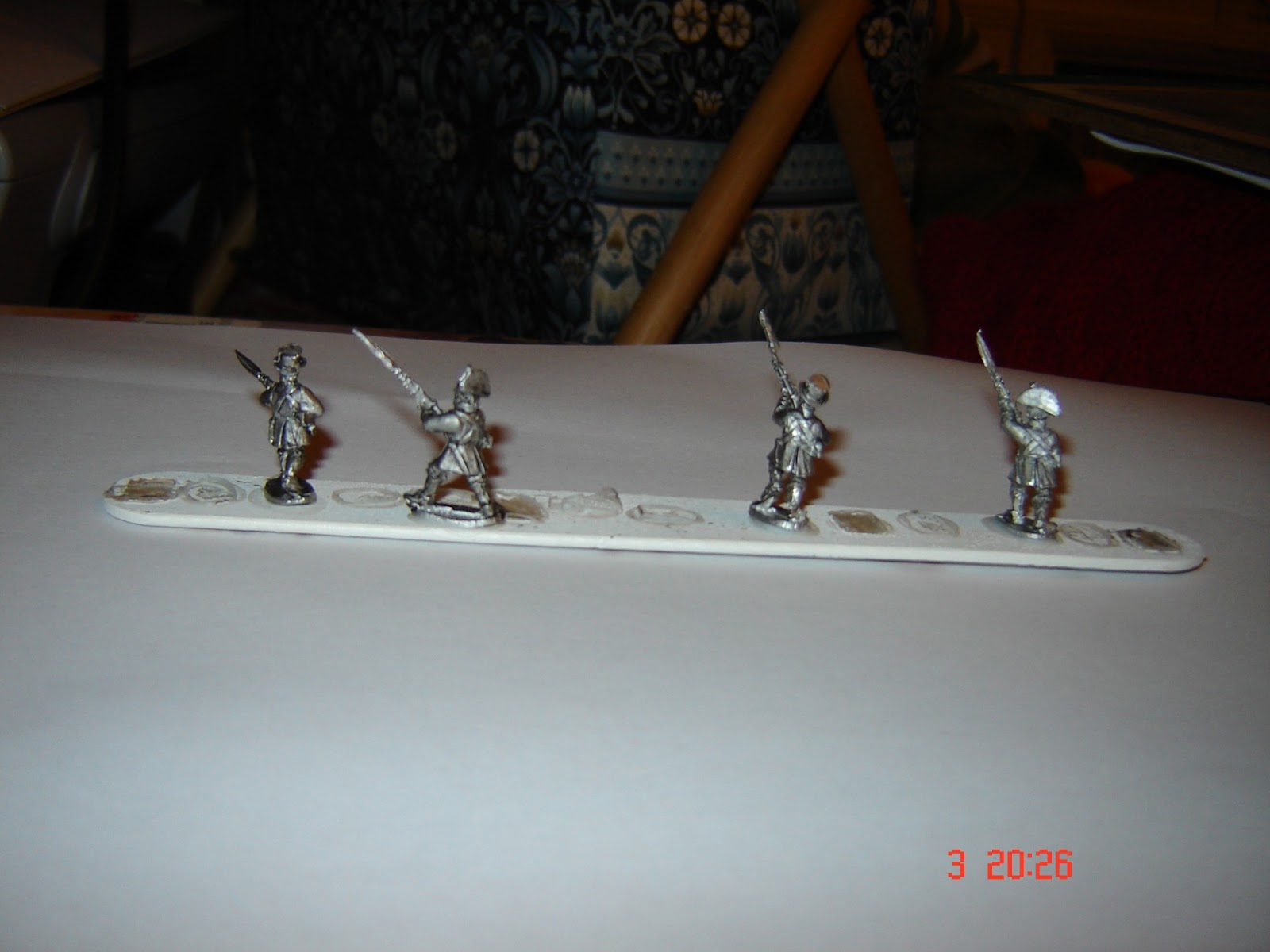
Here are the four options for ranks and file - two in top hat, and two in bicorne. I've no idea whether the packing in these is consistent or not but there are twice as many top hat guys as bicorne chaps.

And here are the same figures from behind.

I think the command figures are weaker sculpts (see above). The top hat standard bearer, to me, doesn't fit with the mad charge of the other figures in the bag, and the left arm on the bicorne standard bearer looks like it has just been stuck on the torso (also the flagpole goes right across the face of the bearer - which means if you are planning on removing it to replace with brass wire, you'd best have a steady hand). The officer in top hat works pretty well but his bicorne counterpart looks awful to me. There is only one drummer (in top hat) who looks okay. In all there are 4 command groups included (two bicorne officer and standard bearers and the same again with top hats - plus four drummers in top hats).

And the same figures from behind.
So, overall, these weren't bad figures - nice energetic poses, some nice details but let down by the usual OG niggles of poor finish and occasional iffy sculpting. Thinking about it, I'm inclined to ditch some of the command figures and replace them with AB. Two options occur to me. First, as many of the militia units were commanded by officers seconded from regular battalions or brought back from retirement, use regular line infantry command figures, and secondly, as AB do some Spanish militia packs buy a pack of officers for those.

Next, a picture of the rank and file with the usual AB French Line figure, his Blue Moon French counterpart, and a Xan miniatures French Legere figure.
.JPG)
And the command figures with the same figures for comparison. I've also slipped in an AB Spanish Militia officer who seems, to me, to work quite nicely.
All in all, I liked these figures, in some respects they are the nicest OG figures I've yet seen. I think they'll be simple to paint and work quite nicely. Of course,
The Juntas, in an attempt to resist the French, raised a huge number of militia units. These initially used Spanish equipment, and, as time went on increasing amounts of British made uniforms and muskets. Unfortunately, prior to 1808 most Spanish defence expenditure had gone into the navy - the army was definitely the poor relation. Also the conflict between church, state and nobility prior to the war meant that the Spanish officer corps had undergone little formal training, was stultified in its practices, and generally incompetent. What this meant was that when the Juntas sought officers for the new militia units they naturally looked at former or serving officers from the army - on paper these people looked qualified to train and lead, but unfortunately all too many were useless at both.
The men, saddled with poor equipment, hopeless officers and a lack of training, behaved as you'd expect when thrown into action before they were ready - given a fixed position to defend they were competent but all too often their officers sought to manoeuvre battalions whose soldiers couldn't manage basic drills. When Spanish militia went into battle they frequently ran like rabbits in the face of the French - the lack of Spanish cavalry meant that the French horse could ride down fleeing Spanish with impunity leading to horrendous casualties. The survivors would melt away or be reformed into a new battalion. Conflicting information, continual destruction and reformation of battalions mean that it is almost impossible to produce a comprehensive list of units created in the Peninsula War.
And yet, when they were given time to learn their drills, and were properly led, they could be steadfast in the extreme. It should be remembered that, even though they were thrashed time and again, the Spanish kept coming back for more....
The 15mm Old Glory SPN5 Militia bag allows you to build these ephemeral battalions of inexperienced, badly equipped, ill fed and ill led men from the first years of the war. As you would expect there are the usual 50 figures in the bag. My initial reaction upon seeing them was that they were very nice by OG standards - there are eight different figures in the bag. The figures are wearing bicornes and the "top hat" favoured by the Spanish (which looked very similar to that worn by Royal Marines of the period) and are wearing a smock-like jacket. All of the figures are in that rushing forward high porte sort of pose that OG favour. Amazingly, to me, the rank and file actually had faces that looked human (I've had figures from the OG ACW range - and OG Austrian Napoleonics - whose faces were shapeless lumps of lead). The musket detail was a bit rough, and weak points meant there is a good chance of losing a figure or two as the musket (not the bayonet, the musket) breaks apart.

Here are the four options for ranks and file - two in top hat, and two in bicorne. I've no idea whether the packing in these is consistent or not but there are twice as many top hat guys as bicorne chaps.
And here are the same figures from behind.

I think the command figures are weaker sculpts (see above). The top hat standard bearer, to me, doesn't fit with the mad charge of the other figures in the bag, and the left arm on the bicorne standard bearer looks like it has just been stuck on the torso (also the flagpole goes right across the face of the bearer - which means if you are planning on removing it to replace with brass wire, you'd best have a steady hand). The officer in top hat works pretty well but his bicorne counterpart looks awful to me. There is only one drummer (in top hat) who looks okay. In all there are 4 command groups included (two bicorne officer and standard bearers and the same again with top hats - plus four drummers in top hats).

And the same figures from behind.
So, overall, these weren't bad figures - nice energetic poses, some nice details but let down by the usual OG niggles of poor finish and occasional iffy sculpting. Thinking about it, I'm inclined to ditch some of the command figures and replace them with AB. Two options occur to me. First, as many of the militia units were commanded by officers seconded from regular battalions or brought back from retirement, use regular line infantry command figures, and secondly, as AB do some Spanish militia packs buy a pack of officers for those.

Next, a picture of the rank and file with the usual AB French Line figure, his Blue Moon French counterpart, and a Xan miniatures French Legere figure.
.JPG)
And the command figures with the same figures for comparison. I've also slipped in an AB Spanish Militia officer who seems, to me, to work quite nicely.
All in all, I liked these figures, in some respects they are the nicest OG figures I've yet seen. I think they'll be simple to paint and work quite nicely. Of course,
Saturday, 1 June 2013
Why Foreigners Get So Confused By The British...And A Diversion
As I work for a company owned by French & Portuguese companies this seems rather familiar:

Some weeks ago a friend and I were talking about modern life and I commented that the advent of satellite TV and the proliferation of channels meant that, as a nation, our shared experiences were becoming more dilute. When I was a boy (in the late Sixties / early Seventies) there were just three TV channels (in black & white to boot) and the coming of Channel 4 was a big deal. What this meant was that, as a country, a good chunk of the population watched the same programmes - I fondly remember "The Likely Lads" and "World at War" - which gave all of us some shared references - these days we're all watching different things. I also seem to have a busier life than when I was seven or eight years old - missing an episode of a series seems to be very easy for me these days.
Anyway I said I had a list of TV programmes that I wanted to watch but hadn't got round to yet - "The Wire" being one such. Anyway, to get to the point, my friend said I should watch "Battlestar Galactica" - to which I replied "I'll bear it in mind" (see image above for translation). To my surprise a DVD of the pilot and 1st series arrived in the post a few days later.
Last week, as I cleaned some 15mm ABs I'd got from eBay (you know the kind of thing - "50 part painted AB figures" that you can't really see - so I get them and they are ABs, and they have been part painted. But whomever started them was presumably using a house painting brush.) I put the first DVD on. The pilot was a bit slow (scene setting, establishing the characters, all that c**p) but the first series itself was quite fun - it is a rather grimy military drama that is set in space and covers some fairly serious ground without beating you round the head with it. It also is about as far from "Star Trek" as you can get - no photon torpedoes or phasers, no shields, and intelligent storylines that stretch over several episodes. The show ran from 2004 - 2009 and is definitely a product of it's time - themes discussed include suicide bombers, responses to terrorism, religion, identity, all kinds of stuff. I'm planning to pick up the remaining series (there were four).


Some weeks ago a friend and I were talking about modern life and I commented that the advent of satellite TV and the proliferation of channels meant that, as a nation, our shared experiences were becoming more dilute. When I was a boy (in the late Sixties / early Seventies) there were just three TV channels (in black & white to boot) and the coming of Channel 4 was a big deal. What this meant was that, as a country, a good chunk of the population watched the same programmes - I fondly remember "The Likely Lads" and "World at War" - which gave all of us some shared references - these days we're all watching different things. I also seem to have a busier life than when I was seven or eight years old - missing an episode of a series seems to be very easy for me these days.
Anyway I said I had a list of TV programmes that I wanted to watch but hadn't got round to yet - "The Wire" being one such. Anyway, to get to the point, my friend said I should watch "Battlestar Galactica" - to which I replied "I'll bear it in mind" (see image above for translation). To my surprise a DVD of the pilot and 1st series arrived in the post a few days later.
Last week, as I cleaned some 15mm ABs I'd got from eBay (you know the kind of thing - "50 part painted AB figures" that you can't really see - so I get them and they are ABs, and they have been part painted. But whomever started them was presumably using a house painting brush.) I put the first DVD on. The pilot was a bit slow (scene setting, establishing the characters, all that c**p) but the first series itself was quite fun - it is a rather grimy military drama that is set in space and covers some fairly serious ground without beating you round the head with it. It also is about as far from "Star Trek" as you can get - no photon torpedoes or phasers, no shields, and intelligent storylines that stretch over several episodes. The show ran from 2004 - 2009 and is definitely a product of it's time - themes discussed include suicide bombers, responses to terrorism, religion, identity, all kinds of stuff. I'm planning to pick up the remaining series (there were four).
But, best of all, it features a Canadian actress / model called Tricia Helfer - who frankly, makes me stupid whenever I see her on screen - believe it or not, she plays a Cylon - and she does it very well (and before you ask I'm not being sarcastic here, she actually is very good in the role). I usually leave gratuitous shots of good looking ladies to Legatus Hedlius but for this woman I'll make an exception!
Monday, 20 May 2013
French Ligne Taking A Pounding Part Deux
About a year ago I posted a picture of an unfinished French Ligne Battalion in a firing line - I'd simply dug into the "big box" and looked through it looking for something I felt like tackling (like tackling the numerous half finished battalions was too much for me). I'd painted the AB French in firing loading poses I had but needed to bulk out the unit to thirty figures by using some casualties - I don't care what anybody says, if I've spent this long painting them the casualties are going to "count" for firing or melee purposes.
Anyway, it occurred to me that I'd not posted a picture of the completed unit. So here you go:
.JPG)
.JPG)
.JPG)
Saturday, 18 May 2013
Battle Honours BSP3 Spanish Infantry Defending Review
Apologies for not posting for a few weeks - I had ten days in Scotland visiting my Uncle, and I've had a lot of work on. Just a quick photo review of the first of the Spanish infantry packs I bought at Salute. This one was BSP3 Spanish Infantry Defending - £15.00 for 50 infantry including three command sets (although I got 10% off because I'm a megalomaniac who couldn't resist spending more than £90 at the show with the chaps at Timecast).
I've bought one or two bags of Battle Honours troops in the past that have been a bit rough (and I'm not the only one - after the show, Giles and I had a few glasses of wine with Dave Brown and some of the chaps from Loughton Strike Force and at least one of them had had the same issue previously) - the moulds seem to be coming to the end of their natural lifespan on some of the more popular bags and are rougher castings than they used to be. I'm pleased to say, these Spanish are very nice - not as clean as AB castings but generally fine. They all seem to have an issue with a bit of roughness on the lower side of the bicorne, particularly where the bottom of the bicorne and the figure's shoulders are in close proximity - but this is nothing that a few moments with a file can't fix. Apart from that it is the usual vent scrap, a little bit of flash on the bayonets (which seem to vary between quite long on some figures and quite short on others) and a few chunks on the bottom of the base. The metal isn't super hard so clean up is no problem.
So, the first thing to say is that BH don't do separate packs of grenadiers (which is odd as the Spanish generally used grenadier companies in converged battalions) so there are grenadiers wearing their distinctive bearskin mixed in with the regular line infantry in bicornes. Out of the 50 figures 16 are grenadiers. This is also a somewhat haphazardly packed bag (more on this later) in another sense: Spanish Infantry "Defending" made me think of chaps preparing to receive a charge, firing their muskets and so on. And I did see some of those in the pack (8 grenadiers and 12 chaps in bicornes) - the balance of the bag are troops standing with their muskets on their shoulders, and the command groups.

First Picture shows the two different standing grenadiers you get (6x of the one on the left, 2x the one on the right) - I really like these, good detail, a bit of character, nicely cast, excellent figures. The standard bearer I'm not quite so keen on - there's nothing terribly wrong with him, it's a good pose that will work with both the "standing around" figures and the "defending figures" - but he doesn't grab me (as I only got two of these I guess that is okay). And that flagstaff will need to be replaced as it is rather weedy. The drummer is another fine figure (3 of these in the bag) - the black wash really brought out the character on this chap - you can see the flash on the bicorne (I've removed excess metal from air vents and the small amount of flash from the bottom of the base on some figures but, otherwise, these are as bought). And finally the officer - when I first looked at him I really didn't take to him - frankly, I thought the pose looked a bit effeminate (which, given the poor calibre of so many Spanish officers, might be rather apt) but again, now that the wash is on, he is rather growing on me.

And the same figures from behind.

Next up, more rank and file including the two "defending" poses. As far as I could tell there were no pose variants with these two - you just got 12 of the bicorne defender, and 8 of the grenadier. The figures are very similar in pose but aren't just a head swap - the grenadier has gaiters, his cartridge case has a grenade symbol on it and he has the sword bayonet in it's scabbard. And finally we have the three "standing around" poses to finish off the pack - I got nine of the middle figure, three of the chap with the musket over his right shoulder, and two chaps smoking a cigarette.

And the same figures from behind.
Now if you've been keeping pace with the numbers of figures in each pose I've been mentioning, you will see that, while I got exactly 50 figures in the bag, only 20 were actually in what I'd term a "defending" pose - and of those you'd need to use the 8 grenadiers separately. So, unless you wanted to mix in the "standing around" figures with the defending figures (perhaps in the second rank? I have a mental image of the front rank being braced to receive cavalry while at least one chap nonchalantly smokes a fag), you won't have enough figures of any one style to make up a 24 figure battalion. And another problem - grenadiers had officers and drummers who wore bearskins, not bicornes - so the 20 grenadiers in the bag have nobody to command them.
All this means that, for me, the packing of this bags is a bit of an issue. At first glance, without counting figures you'd think "50 figures, 3 command groups - okay, two 24 figure battalions with a spare officer and standard bearer" - and you would be dished once you opened the bag and found what you actually had. Obviously, for me, the solution is to simply buy more (when the maths gets tough, the wargamer goes shopping). So, having a second bag of BSP3 in the drawer, I opened it and had a headcount. Now the chap from Loughton had warned me there was some variation between bags (ie it isn't like Wargames Foundry where there was one mould for each pack, and each spin produced one pack, so no variation in what you got each time). This time round I got the following (1st pack count in brackets):
Officer x3 (x3)
Drummer x3 (x3)
Standard Bearer x3 (x2)
Grenadier Defending x9 (x8)
Grenadier Standing Around x8 (x8)
Bicorne Defending x6 (x12)
Bicorne Standing Around x18 (x14)
So, you can see the proportion of grenadier figures is fairly constant, as is the command element, but the mix between standing around and defending varies a bit. Now, looking at the Deep Fried Happy Mice review of BSP1 Spanish Standing & Firing it looks like you get the same command, and standing around figures, along with some guys loading and firing. It would also appear he got some chaps defending too. Plus he got 16 grenadiers. Whether there was a kitchen sink in the bag too he didn't say.
I should also say that the second bag was much more cleanly cast than the bag I used for the photos - little or no roughness on the bicornes and mostly just vent metal on the rest of the figures.
I'm therefore thinking that you have two options with the BH figures. First, just take the bag and paint what you've got, and then use the grenadiers with bicorne command (they were a slovenly lot, the Spanish) and damn the historical accuracy, and mix up the standing and defending guys in bicorne. Secondly, buy three bags and separate the figures to make the best units you can. The AB grenadier command would work with either the standing around or defending poses so you should be able to get two grenadier battalions from three bags, and a 24 figure bicorne defending battalion and a couple of bicorne standing around units as well.
And, just to complicate matters even more, it seems that the foreign regiments didn't necessarily detach their grenadier companies (irritatingly I can't find the thread on TMP that I saw this), so, if you are painting a nice Irish or Swiss unit you could mop up a few grenadier figures by including a stand of those.

And a picture with an AB French Ligne figure, a Blue Moon French Ligne figure and a Campaign Games Miniature figure, a Xan Miniatures Voltigeur and an AB Spanish marching figure for comparison purposes. Sadly, the AB and BH figures don't work terribly well together in my eyes - I think you'd need to slip a thin shim under the BH figures to make them go well together.
And this is a rather more "wordy" photo review than I originally intended - I do blether on!
I've bought one or two bags of Battle Honours troops in the past that have been a bit rough (and I'm not the only one - after the show, Giles and I had a few glasses of wine with Dave Brown and some of the chaps from Loughton Strike Force and at least one of them had had the same issue previously) - the moulds seem to be coming to the end of their natural lifespan on some of the more popular bags and are rougher castings than they used to be. I'm pleased to say, these Spanish are very nice - not as clean as AB castings but generally fine. They all seem to have an issue with a bit of roughness on the lower side of the bicorne, particularly where the bottom of the bicorne and the figure's shoulders are in close proximity - but this is nothing that a few moments with a file can't fix. Apart from that it is the usual vent scrap, a little bit of flash on the bayonets (which seem to vary between quite long on some figures and quite short on others) and a few chunks on the bottom of the base. The metal isn't super hard so clean up is no problem.
So, the first thing to say is that BH don't do separate packs of grenadiers (which is odd as the Spanish generally used grenadier companies in converged battalions) so there are grenadiers wearing their distinctive bearskin mixed in with the regular line infantry in bicornes. Out of the 50 figures 16 are grenadiers. This is also a somewhat haphazardly packed bag (more on this later) in another sense: Spanish Infantry "Defending" made me think of chaps preparing to receive a charge, firing their muskets and so on. And I did see some of those in the pack (8 grenadiers and 12 chaps in bicornes) - the balance of the bag are troops standing with their muskets on their shoulders, and the command groups.

First Picture shows the two different standing grenadiers you get (6x of the one on the left, 2x the one on the right) - I really like these, good detail, a bit of character, nicely cast, excellent figures. The standard bearer I'm not quite so keen on - there's nothing terribly wrong with him, it's a good pose that will work with both the "standing around" figures and the "defending figures" - but he doesn't grab me (as I only got two of these I guess that is okay). And that flagstaff will need to be replaced as it is rather weedy. The drummer is another fine figure (3 of these in the bag) - the black wash really brought out the character on this chap - you can see the flash on the bicorne (I've removed excess metal from air vents and the small amount of flash from the bottom of the base on some figures but, otherwise, these are as bought). And finally the officer - when I first looked at him I really didn't take to him - frankly, I thought the pose looked a bit effeminate (which, given the poor calibre of so many Spanish officers, might be rather apt) but again, now that the wash is on, he is rather growing on me.

And the same figures from behind.

Next up, more rank and file including the two "defending" poses. As far as I could tell there were no pose variants with these two - you just got 12 of the bicorne defender, and 8 of the grenadier. The figures are very similar in pose but aren't just a head swap - the grenadier has gaiters, his cartridge case has a grenade symbol on it and he has the sword bayonet in it's scabbard. And finally we have the three "standing around" poses to finish off the pack - I got nine of the middle figure, three of the chap with the musket over his right shoulder, and two chaps smoking a cigarette.

And the same figures from behind.
Now if you've been keeping pace with the numbers of figures in each pose I've been mentioning, you will see that, while I got exactly 50 figures in the bag, only 20 were actually in what I'd term a "defending" pose - and of those you'd need to use the 8 grenadiers separately. So, unless you wanted to mix in the "standing around" figures with the defending figures (perhaps in the second rank? I have a mental image of the front rank being braced to receive cavalry while at least one chap nonchalantly smokes a fag), you won't have enough figures of any one style to make up a 24 figure battalion. And another problem - grenadiers had officers and drummers who wore bearskins, not bicornes - so the 20 grenadiers in the bag have nobody to command them.
All this means that, for me, the packing of this bags is a bit of an issue. At first glance, without counting figures you'd think "50 figures, 3 command groups - okay, two 24 figure battalions with a spare officer and standard bearer" - and you would be dished once you opened the bag and found what you actually had. Obviously, for me, the solution is to simply buy more (when the maths gets tough, the wargamer goes shopping). So, having a second bag of BSP3 in the drawer, I opened it and had a headcount. Now the chap from Loughton had warned me there was some variation between bags (ie it isn't like Wargames Foundry where there was one mould for each pack, and each spin produced one pack, so no variation in what you got each time). This time round I got the following (1st pack count in brackets):
Officer x3 (x3)
Drummer x3 (x3)
Standard Bearer x3 (x2)
Grenadier Defending x9 (x8)
Grenadier Standing Around x8 (x8)
Bicorne Defending x6 (x12)
Bicorne Standing Around x18 (x14)
So, you can see the proportion of grenadier figures is fairly constant, as is the command element, but the mix between standing around and defending varies a bit. Now, looking at the Deep Fried Happy Mice review of BSP1 Spanish Standing & Firing it looks like you get the same command, and standing around figures, along with some guys loading and firing. It would also appear he got some chaps defending too. Plus he got 16 grenadiers. Whether there was a kitchen sink in the bag too he didn't say.
I should also say that the second bag was much more cleanly cast than the bag I used for the photos - little or no roughness on the bicornes and mostly just vent metal on the rest of the figures.
I'm therefore thinking that you have two options with the BH figures. First, just take the bag and paint what you've got, and then use the grenadiers with bicorne command (they were a slovenly lot, the Spanish) and damn the historical accuracy, and mix up the standing and defending guys in bicorne. Secondly, buy three bags and separate the figures to make the best units you can. The AB grenadier command would work with either the standing around or defending poses so you should be able to get two grenadier battalions from three bags, and a 24 figure bicorne defending battalion and a couple of bicorne standing around units as well.
And, just to complicate matters even more, it seems that the foreign regiments didn't necessarily detach their grenadier companies (irritatingly I can't find the thread on TMP that I saw this), so, if you are painting a nice Irish or Swiss unit you could mop up a few grenadier figures by including a stand of those.

And a picture with an AB French Ligne figure, a Blue Moon French Ligne figure and a Campaign Games Miniature figure, a Xan Miniatures Voltigeur and an AB Spanish marching figure for comparison purposes. Sadly, the AB and BH figures don't work terribly well together in my eyes - I think you'd need to slip a thin shim under the BH figures to make them go well together.
And this is a rather more "wordy" photo review than I originally intended - I do blether on!
Subscribe to:
Posts (Atom)


